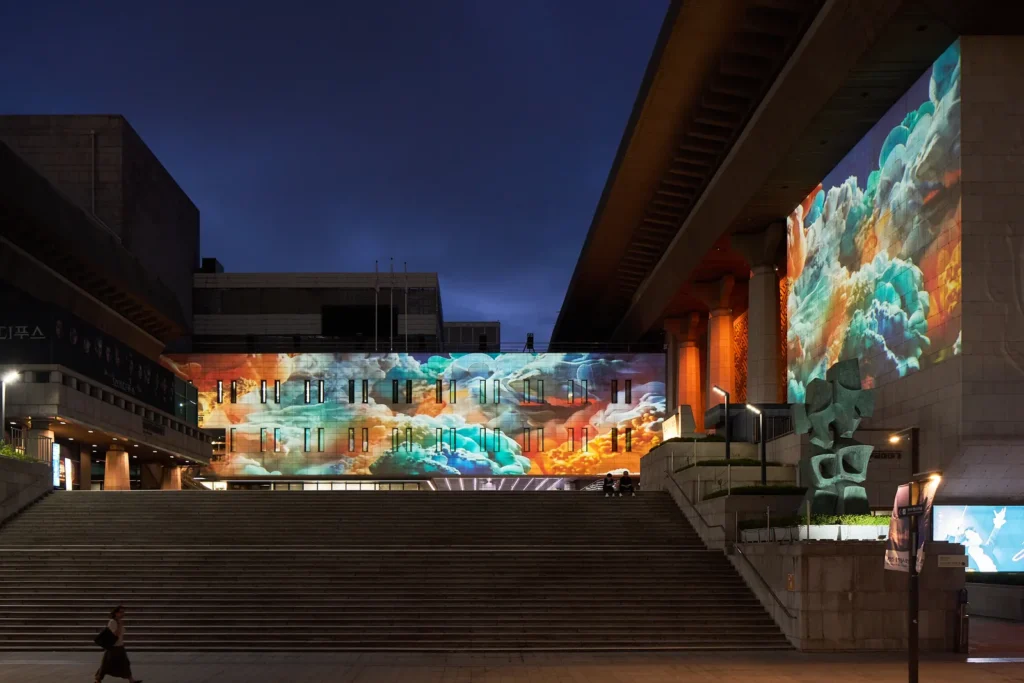
기상청 국가기후데이터센터의 5개년(2020~2024) 기후 데이터를 인공지능 프롬프트의 파라미터 값으로 직접 입력하여, 데이터의 수치 변동이 곧 화면의 색감과 패턴의 변동으로 치환되는 영상 작업이다. 기온, 습도, 바람, 강수량 등 정량적 정보가 시각 언어로 변환되는 일련의 과정이 작업의 구조를 이룬다.
연화문, 보상화문, 구름문은 자연을 추상화한 도상이며, 적·청·황·백·흑의 오방색은 방위와 절기를 색으로 환원한 체계이다. 인공지능은 이 도상과 색채 체계를 학습 데이터로 삼아 기후 데이터에 반응하며, 각기 다른 잉크가 한 화면 안에서 섞이지 않는 구성으로 펼쳐진다.
작업의 중심 축은 24절기이다. 24절기는 농경 사회가 태양의 황도상 위치를 기준으로 한 해를 분할하던 시간 체계이며, 절기명 자체가 기상 현상의 언어이다. 본 작업은 각 절기를 기후 데이터의 단면으로 환원하고 단청 문양으로 다시 그려내며, 대한의 잔설이 다시 입춘의 새싹으로 이어지는 회귀의 구조를 갖는다. 농경의 순환적 시간관이 선형적 데이터 축적과 교차할 때 어떤 형상으로 재구성되는지, 그리고 텍스트와 수치가 이미지로 변환되는 동시대적 조건이 전통의 시간 체계를 어떻게 다시 읽게 하는지를 묻는다.
This is a video work in which five-year (2020–2024) climate data from the National Climate Data Center of the Korea Meteorological Administration is entered directly as parameter values in artificial intelligence prompts, so that numerical fluctuation in the data is transposed into fluctuation of color and pattern on the screen. The structure of the work is formed by the sequence through which quantitative information such as temperature, humidity, wind, and precipitation is converted into visual language.
The lotus pattern (yeonhwamun), the idealized flower pattern (bosanghwamun), and the cloud pattern (unmun) are icons that abstract nature, while obangsaek, the five colors of red, blue, yellow, white, and black, is a system that reduces direction and solar term to color. The artificial intelligence takes this iconographic and chromatic system as training data and responds to the climate data, unfolding as a composition in which different inks do not blend within a single frame.
The central axis of the work is the twenty-four solar terms. The twenty-four solar terms constitute a temporal system by which agrarian society divided the year according to the position of the sun along the ecliptic, and the names of the terms are themselves a language of meteorological phenomena. This work reduces each solar term to a cross-section of climate data and redraws it as a dancheong pattern, taking on a recursive structure in which the residual snow of Daehan (Major Cold) leads again into the new shoots of Ipchun (Beginning of Spring). It asks what form is reconstituted when the cyclical time of agriculture intersects with linear data accumulation, and how the contemporary condition in which text and numerical values are converted into images causes the traditional system of time to be read again.