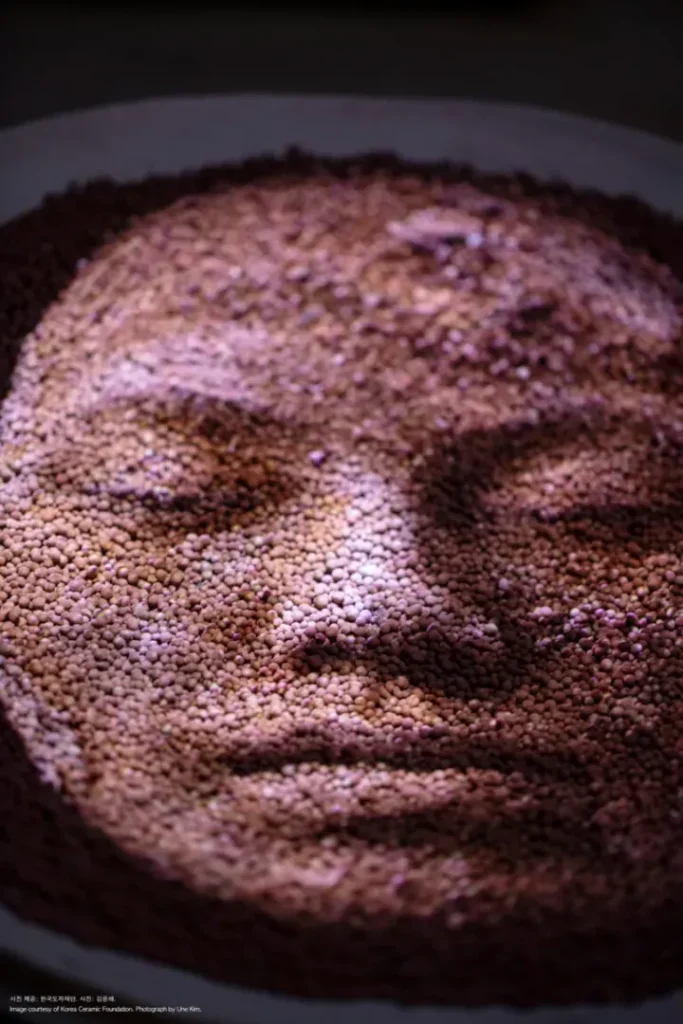
〈물면시기〉는 여섯 점의 도자 접시 위에 인공지능이 생성한 인물과 목소리를 투사하는 6채널 설치이다. 각 접시는 한국, 영국, 중국, 일본, 스페인, 네덜란드 가운데 하나의 땅과 하나의 언어를 맡는다. 제목은 “사물은 잠들고, 때가 되면 일어난다”로 읽힌다.
각 접시에는 그 땅의 지질과 도자 전통에 대응하는 흙과 돌, 껍데기가 담긴다. 작가는 원산지의 흙을 들여오는 대신 국내에서 구할 수 있는 대응 재료를 택하였다. 재료는 땅에서 떼어 온 표본이 아니라 땅을 옮겨 적은 번역이며, 원본과 번역 사이의 거리가 작품이 서 있는 자리가 된다.
접시 위의 화자는 자신이 누구인지 밝히지 않는다. 졸다가 깨어난 목소리는 몸이 생겨난 내력, 그 땅에 전해 오는 신화와 의례, 불과 손을 거쳐 몸이 바뀐 이야기를 차례로 들려주고, 그 사이마다 잠결의 노래를 흥얼거린다. 화자는 그 일을 직접 겪었는지 전해 들었는지 확신하지 못하며, 검증된 물성의 사실과 구전의 기억이 한 목소리 안에서 같은 무게로 섞인다. 관람자는 흩어진 단서를 모아 화자가 무엇인지 스스로 짐작하게 된다. 목소리와 노래, 영상은 각국의 도자 기관과 작가가 제공한 연구 자료, 그리고 땅과 흙에 관한 조사 데이터를 바탕으로 인공지능이 생성하였다. 노래는 각 문화권의 민요, 노동요, 의례가, 자장가의 형식을 따르되 공연이 아닌 잠결의 흥얼거림으로 남는다.
여섯 채널은 60분을 주기로 잠들고 깨어난다. 한 좌대가 깨어 말하는 동안 나머지는 대부분 어둠 속에서 졸고 있으며, 여섯 화자가 깨어나는 계기도 저마다 다르다. 바깥의 발소리, 소리의 부재, 가마의 온도, 낯선 손, 돌아오는 해와 달, 제 몸이 내는 소리가 각각의 화자를 깨운다. 발화는 좌대를 건너 릴레이처럼 이어지고, 때로는 한 좌대의 말 위로 다른 좌대의 노래가 멀리서 겹치며, 주기마다 여러 차례 여섯 좌대가 모두 잠드는 정적이 찾아온다. 오브제가 언제 깨어날지는 관람객이 아니라 사물이 정한다. 관람객은 기다림 속에서 사물의 시간에 자신을 맞추어야 하며, 작가는 이 상태를 ‘지속하는 불편함’이라 부르고 작업의 핵심 가치로 삼는다.
이 작업에서 인공지능은 도구가 아니라 연결망을 이루는 또 하나의 행위체이다. 흙과 돌, 도자, 기관의 아카이브, 생성 모델, 관람자가 서로를 조건 짓는 틈에서 사물은 인간의 언어 바깥에 스스로를 드러낼 자리를 얻는다. 작가는 이를 제노 발화(Xeno-enunciation)라 부른다. 가장 오래된 매체인 흙과 가장 새로운 생성 체계가 한 접시 위에서 만나고, 여섯 언어가 한 방 안에서 교차하며 문화의 흐름과 그 이면의 경계를 조용히 환기한다. 졸다가 깨다가 하는 사물의 리듬은 무감각해진 채 이따금 깨어나는 우리의 상태와도 겹쳐진다. 사물은 다시 잠들고, 때가 되면 또 일어난다.
본 작업은 2026 경기도자비엔날레 본전시《땅이 만든다》의 커미션 작품으로 제작되었다.
Still, Softly Stirring is a six-channel installation in which AI-generated figures and voices are projected onto six ceramic plates. Each plate takes on one land and one language: Korea, the United Kingdom, China, Japan, Spain, and the Netherlands. The title may be read as “things fall asleep, and rise when the time comes.”
Each plate holds soil, stone, or shell corresponding to the geology and ceramic traditions of its land. Rather than importing earth from the places of origin, the artist chose equivalent materials obtainable in Korea. The materials are not specimens taken from the land but translations of it, and the distance between original and translation becomes the ground on which the work stands.
The narrator on each plate never states what it is. Waking from a doze, the voice recounts in turn the origins of its body, the myths and rituals handed down in its land, and the transformations its body underwent through fire and hands, humming half-asleep songs in between. The narrator cannot be certain whether it lived these events or only heard of them, and verified material facts and oral memory carry equal weight within a single voice. Visitors gather the scattered clues and arrive at their own sense of what the narrator might be. The voices, songs, and images were generated by AI from research materials provided by ceramic institutions and artists in each country, together with survey data on land and soil. The songs draw on folk song, work song, ritual chant, and lullaby forms from each culture, yet remain murmurs of sleep rather than performances.
The six channels fall asleep and wake on a 60-minute cycle. While one plinth wakes and speaks, the others mostly doze in darkness, and each of the six narrators is woken by something different: footsteps outside, the absence of sound, the heat of a kiln, unfamiliar hands, the returning sun and moon, the sound of its own body. Speech passes from plinth to plinth like a relay; at times a song from one plinth drifts in from afar over another’s words, and several times in each cycle all six fall silent together. It is the objects, not the visitors, that determine when they wake. Visitors must attune themselves to the objects’ time through waiting, a state the artist calls “sustained discomfort” and regards as a central value of the work.
In this work, AI is not a tool but another entity within the network. In the gaps where soil and stone, ceramics, institutional archives, generative models, and visitors condition one another, objects find a place to reveal themselves outside human language, a condition the artist terms Xeno-enunciation. Earth, the oldest of media, meets the newest of generative systems on a single plate, and six languages intersect in one room, quietly evoking the movement of cultures and the boundaries beneath them. The rhythm of objects dozing and waking also overlaps with our own state of numbness, broken now and then by brief awakenings. The things fall asleep again, and when the time comes, they rise once more.
This work was commissioned for the main exhibition of the Gyeonggi Ceramics Biennale 2026, Earth Makes.