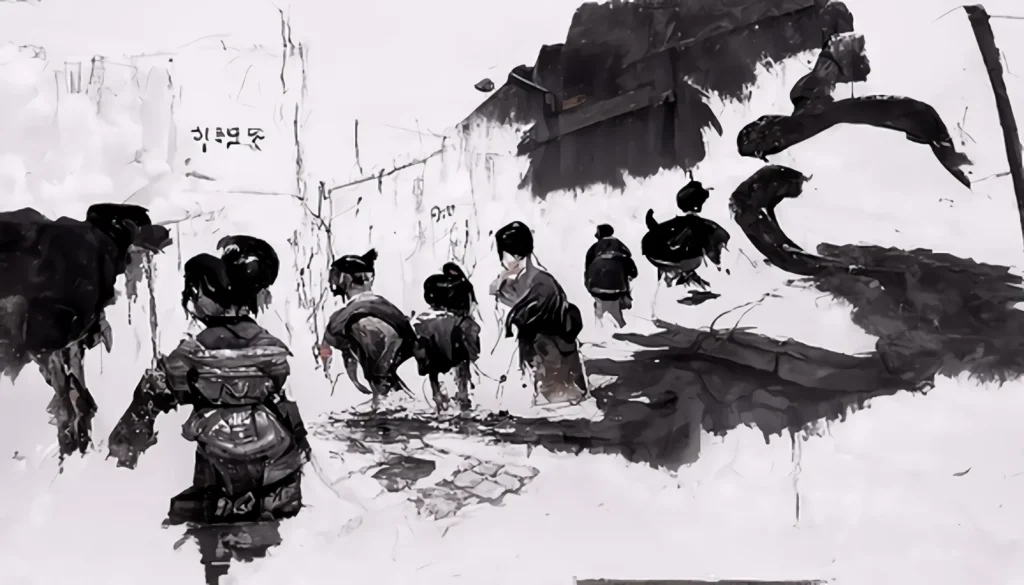
Corvus Series_AI Poetic drawing/ 까마귀속 연작_인공지능 시적 드로잉
이 연작은 인간의 행동을 모방하는 까마귀에서 모티브를 얻고, 순환적인 공명적 접근을 바탕으로 인공지능이 인간의 영역으로 다가오는 상황을 프롬프트 엔지니어링을 바탕으로 문학작품들을 해석하는 시도로 출발하였다.
까마귀속 이란, 유전적 혹은 계통적으로 밀접한 관계를 갖는 근연종들의 그룹을 정리할 때 쓰이는 용어인 속(屬, Genus)을 기준으로 우리가 흔히 알고 있는 까마귀와 그 유사 개체 45종이 모인 분류 기준이다. 이 분류를 하나의 맥락적 기준으로 삼고서, 동시대의 인공지능이 여러 신경망 알고리즘과 상관관계에 있는 링크를 통해 이미지를 생성하듯이, 까마귀 속과 상관되지만 본래는 전혀 다른 문학작품들 사이에서 데이터를 수집하고 이를 인공지능을 통해 다시 변환하여 각각의 작업으로 구현한 형태이다. 이에 대한 설명을 위해 인공지능 생성영상 – 시적 드로잉 시리즈라는 부제와 시리즈의 표기를 덧붙인다.
이 까마귀속을 기준으로 데이터로 수집한 문학 작품을 살펴보면 다음과 같다. 먼저 일제강점기의 문학가인 이상의 ‘오감도’는 한글로 변환하면 ‘까마귀 눈으로 보기(Crow’s eye view)’에 해당된다. 조감도라는 단어로 알려진 새의 시선으로 바라보는 것을 넘어 까마귀라는 존재 특유의 영험함에 빗댄 시의 연작 타이틀로 보인다. 다음으로 미국의 대문호인 애드거 앨런 포의 ‘갈까마귀(The Raven)’이다. 북미 지역의 대표적인 새인 갈까마귀는 세부적으로 말하자면 큰까마귀로 분류될수 있으나, 한국에서는 갈까마귀라는 번역명이 더 많이 쓰인다. 마지막으로는 체코의 대문호 프란츠 카프카의 ‘성’이다. 카프카의 경우는 체코어로 작가의 성씨인 ‘카프카’라는 단어가 체코어 단어 Kavka의 이표기로 추정되며, 이는 ‘검은 까마귀’를 뜻한다.
위의 3 작품과 연관이 있는 까마귀속이라는 키워드를 통해 작품들의 기본적인 컨셉을 정립하고, 각 문학 작품이 풍기는 특유의 분위기 등을 실제 작품 제작에 반영하여 제2 저작물의 형태를 기본적인 골자로 제작하였다.
1)
Crow Eye’s View/ 오감도
– 시인 이상의 ‘오감도’ 시리즈 총 15편을 텍스트 프롬프트(명령어)로 삼고, deep learning(disco diffusion v4/CLIP(Contrastive Language-Image Pretraining),ImageNet model)으로 구성한 영상 시(Video Poetry)이다.
이 작업은 언어로 구성된 문학작품을 다양한 인공-신경망의 작용을 거치는 프로세스를 통해 구성된다. 각 시의 문장 속 텍스트를 근간으로 데이터를 구성하여 영상화으로 생성해낸다. 음악의 경우도 TTS 베이스의 나레이션을 기초로 하며, 인공지능 알고리즘 기반의 생성기로 제작한다. 이는 과거의 문학 작품을 인공지능이 재해석 하여 현대의 작업으로 전환되는 일종의 제2 저작물이다. 또한 시인 이상에 대한 오마주를 20세기 초반 한반도의 수묵화를 바탕으로 영상을 통해 구현하는데 집중하였다.
This series is inspired by crows that mimic human behavior and is an attempt to interpret literary works based on prompt engineering to explore the situation of artificial intelligence coming into the human realm based on a circular resonant approach.
The genus Raven is a classification of 45 species of crows and their relatives, based on the genus, a term used to organize groups of closely related species that are genetically or phylogenetically related. Taking this classification as a contextual reference, just as contemporary artificial intelligence creates images through correlated links with various neural network algorithms, it is a form of collecting data among literary works that are related to the genus of raven but are essentially completely different, and converting them into individual works through artificial intelligence. To explain this, I will add the subtitle A.I. Generated Image – Poetic Drawing Series and the notation of the series.
Let’s take a look at the literary works collected as data based on this genus of ravens.
First, “Ogamdo,” a literary name of the Japanese occupation, translates to “Crow’s eye view” in Korean. It seems to be the title of a series of poems that go beyond the bird’s-eye view known as bird’s-eye view to the spirituality of the crow. Next is “The Raven” by Adger Allen Poe, a major American writer. The raven, a representative bird of North America, can be technically categorized as a raven, but in Korea, it is more commonly translated as a galamsey. Finally, we have the last name of Czech writer Franz Kafka. In the case of Kafka, the word ‘Kafka’, which is the author’s surname in Czech, is believed to be a variant of the Czech word Kavka, which means ‘black crow’.
I established the basic concept of the works through the keyword “crow,” which is related to the above three works, and reflected the unique atmosphere of each literary work in the actual production of the second work as a basic outline.
It is a video poem composed by deep learning (disco diffusion v4/CLIP (Contrastive Language-Image Pretraining), ImageNet model) using a total of 15 episodes of ‘Ogamdo’ series by poet Lee Sang-soo as text prompts (commands). This work is composed through a process of taking a literary work composed of language and subjecting it to the action of various artificial and neural networks. The data is organized based on the text in the sentences of each poem to create a video. In the case of music, it is based on TTS-based narration and produced by an AI algorithm-based generator. This is a kind of secondary work in which past literary works are reinterpreted by AI and transformed into contemporary works. In addition, we focused on realizing the homage to the poet’s ideal through video based on ink paintings from the Korean peninsula in the early 20th century.